28 Jul 2026 / Subhashish Homes
Here is a question worth sitting with: how much water did your household get through last year?
Most people guess a few thousand litres. The real answer runs closer to two lakh.
A Jaipur family of four, living at the urban supply benchmark set by the Ministry of Housing and Urban Affairs, moves roughly 197,000 litres through its home every twelve months. That works out to about forty tanker loads, for one family, in a semi-arid state where the water table keeps sinking.
This blog breaks down exactly where all of it goes, why Jaipur feels the strain more sharply each year, and how a well-planned home brings that number down. If you are weighing the sustainable homes Jaipur has to offer, the water story deserves your attention first.
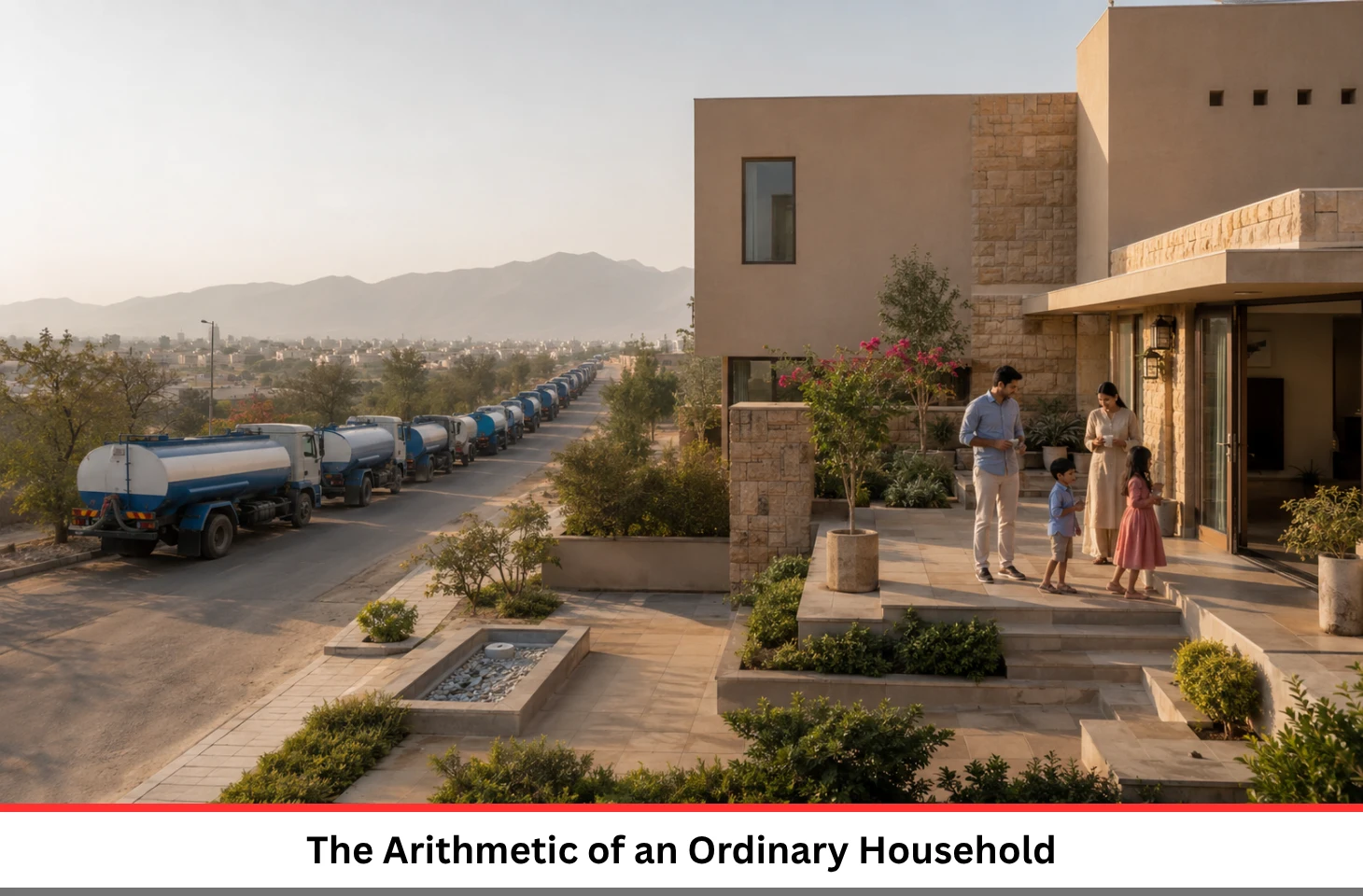
The calculation is refreshingly simple. National guidelines suggest 135 litres per person per day for urban households, and the Central Public Health and Environmental Engineering Organisation recommends 150. Multiply the lower figure by four people and 365 days, and you arrive at 197,100 litres. Use the higher standard and the total climbs beyond 2.19 lakh litres. Either way, one family quietly moves a small reservoir through its home each year.
Very little of that volume ends up in a drinking glass. Bathing and showering claim the largest share of a typical Indian household's use, followed by the flush cistern, then laundry and dishwashing. Cooking and drinking together account for a modest slice of the total. Households with gardens, larger families or frequent guests push the figure higher still, and summer months in Jaipur reliably lift consumption as coolers, plants and extra baths enter the routine.
Understanding this split matters, because it reveals where savings actually live. Efficient fittings in bathrooms and a smarter flush deliver far more benefit than carefully turning off the kitchen tap, useful as that habit remains.
Here the story turns instructive. While the benchmark sits at 135 litres per person daily, studies of Jaipur's civic supply have long placed actual availability closer to 85 or 90 litres at the consumer end, well under the national standard. Distribution losses across ageing pipelines explain a large part of that shortfall.
Families bridge the difference in familiar ways: borewells, private tankers, storage tanks topped up whenever the supply arrives. Each of these workarounds carries a cost, whether measured in rupees, in electricity, or in the slow withdrawal of groundwater beneath the city. The gap between what a household needs and what the network delivers is the quiet daily reality behind that two lakh litre annual figure.
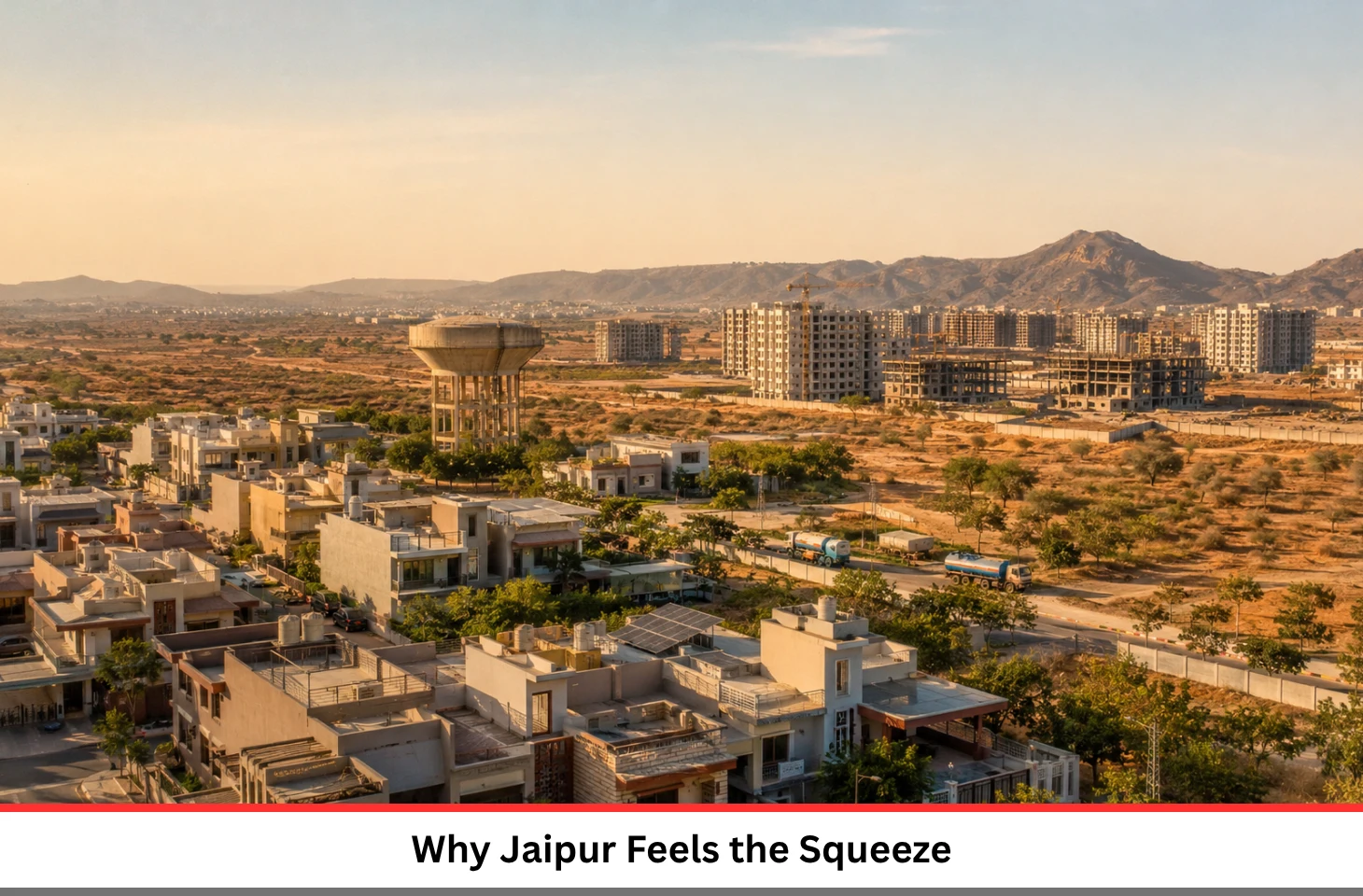
Jaipur receives around 600 millimetres of rain each year, most of it compressed into the monsoon weeks between July and September. That is a modest allowance to begin with, and the city has grown quickly around it. Bisalpur Dam, more than a hundred kilometres away on the Banas, now carries much of the municipal load, while thousands of tubewells handle the remainder.
The underground story explains the urgency. Official assessments have placed a large majority of Rajasthan's blocks in the over-exploited category, meaning more water is drawn each year than nature returns. Jaipur district has carried the highest count of such blocks in the state. Water tables across Rajasthan have been receding by roughly one to three metres annually in many areas, which is why borewells keep going deeper and older ones keep running dry.
Around ninety percent of the state's drinking water has historically come from underground, so this decline touches every household, including those that rely purely on the municipal line. Recognising this, the state passed the Rajasthan Groundwater Conservation and Management Authority Bill in 2025, bringing extraction under formal regulation, requiring permission for new borewells, and setting penalties for unauthorised drilling. The message from policy is clear: groundwater has moved from a private convenience to a shared public resource.
Regulation has reached construction as well. Rooftop rainwater harvesting is mandatory for buildings above specified plot sizes across urban Rajasthan, and civic bodies have tied completion certificates and water connections to compliance. Rajasthan also ranks among the leading states nationally for the sheer number of water conservation and recharge structures built in recent years.
For anyone comparing green housing Jaipur offers today, this shifts the question. Water systems are becoming a legal baseline, so the meaningful difference lies in how thoroughly a developer goes beyond the minimum.
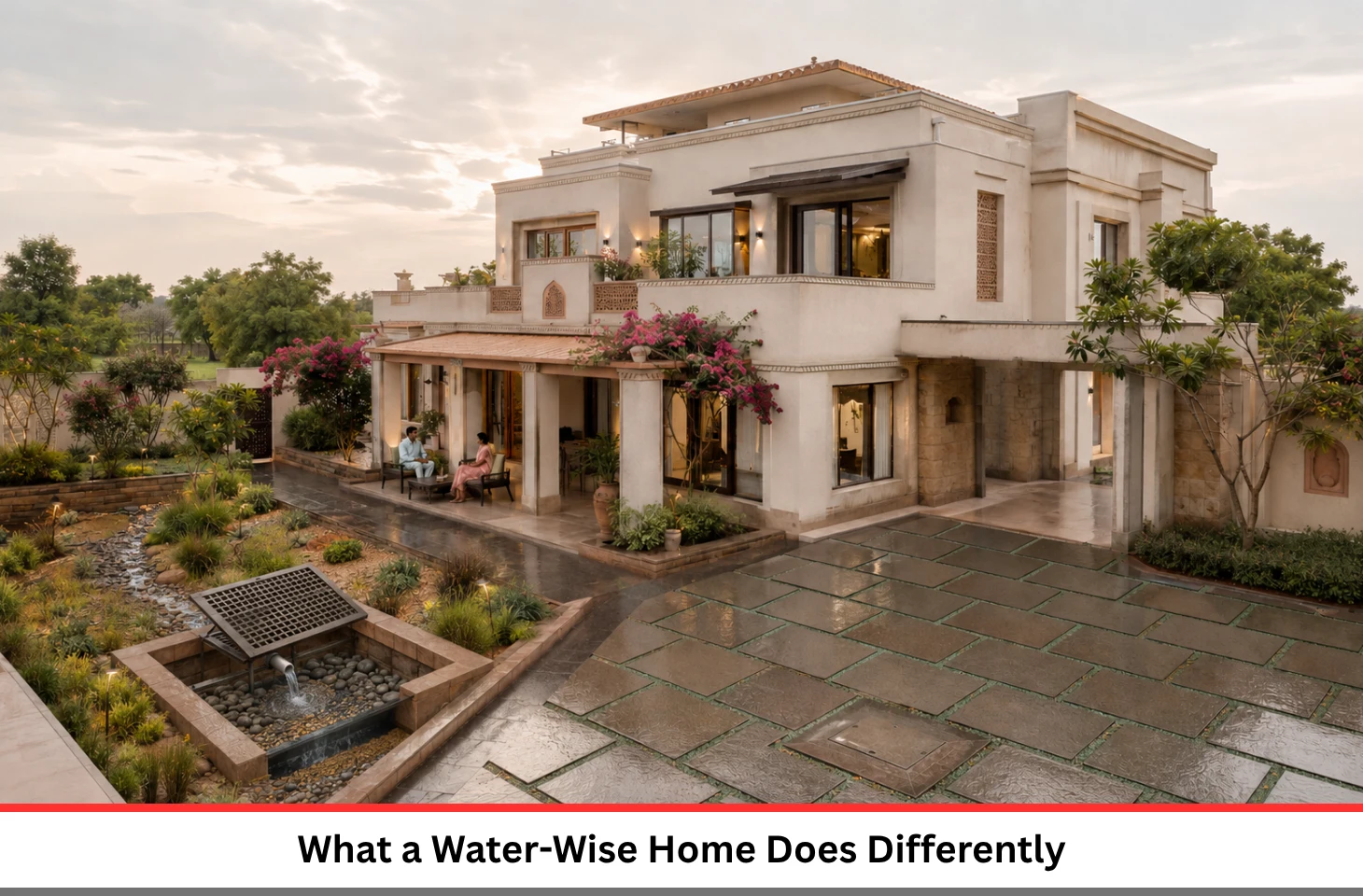
The encouraging part of this story is how much a well-planned home can change the arithmetic. Three systems carry most of the weight.
Take a rooftop of 200 square metres in a city receiving 600 millimetres of rain. Even allowing for realistic collection losses, that surface can gather roughly 96,000 litres in a single monsoon, nearly half of what our family of four uses across an entire year. Widen the catchment to 300 square metres and the yield rises to around 1.44 lakh litres.
Community-scale harvesting multiplies the effect. When a residential development channels runoff from clubhouse roofs, internal roads and paved areas into recharge pits and storage tanks, it captures volumes an individual home could only dream of, and it puts water back into the aquifer that everyone in the neighbourhood shares. This is the single most powerful lever available to water conservation homes in a monsoon-fed city.
A second lever handles water after use. An on-site sewage treatment plant cleans household wastewater to a standard suitable for landscaping, flushing and washing common areas. Given that gardens and flushing together represent a substantial share of demand in any gated community, recycling covers those needs with treated water and reserves the fresh supply for drinking and bathing. Dual plumbing lines make the arrangement work invisibly in daily life.
The finer details compound the savings. Aerated taps and low-flow showers cut consumption at the point of use while keeping the experience comfortable. Dual-flush cisterns give occupants a choice, saving several litres each time. Drip irrigation delivers water to roots rather than to the air, and native, drought-tolerant planting suits Rajasthan's climate far better than thirsty imported lawns. Permeable paving lets rain soak into the ground rather than rushing into a storm drain, quietly recharging the water table underfoot.
Stack these measures together and a household can reduce its draw on municipal and underground sources by a meaningful margin, which is exactly what water-efficient homes in Jaipur are designed to achieve. The savings arrive as lower bills, greater independence during dry months, and a lighter footprint on a stressed resource.
Water shapes how we plan every community we build. Rainwater harvesting and recharge structures, sewage treatment with treated-water reuse for landscaping, efficient fittings and climate-appropriate planting form part of our standard approach rather than an optional upgrade. The House of Shubhashish holds the IGBC Platinum rating, the highest tier of green certification in India, which assesses water performance alongside energy, materials and site planning. That certification matters because it verifies results instead of accepting claims, and the same water-first thinking guides how we plan our other communities, giving residents of eco-friendly homes Jaipur trusts a standard they can rely on.
The everyday benefit is practical. Families in well-planned sustainable communities spend less on tankers, worry less through peak summer and enjoy green surroundings that thrive on recycled water. Responsible design and comfortable living turn out to be the same thing.
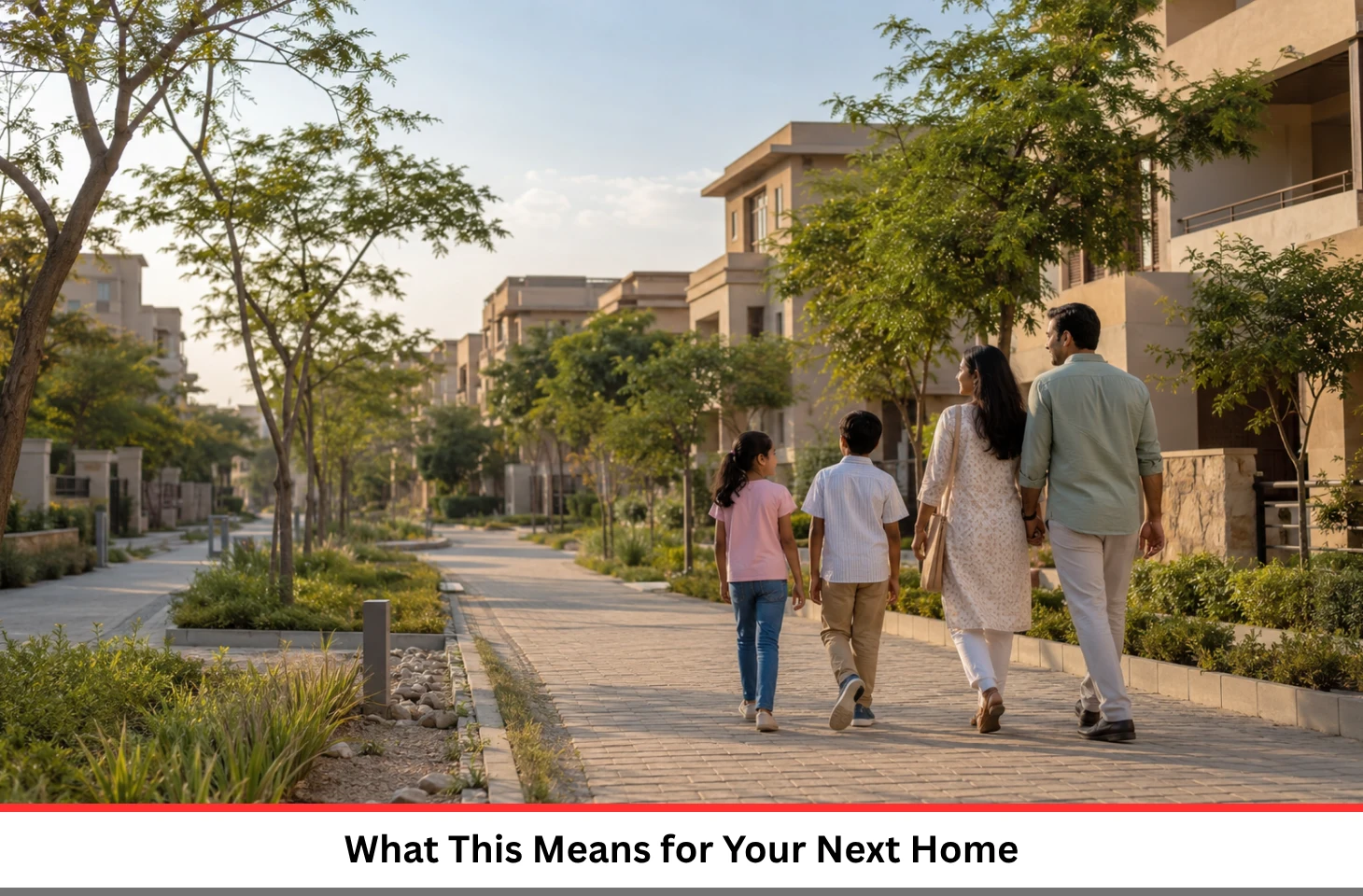
Two lakh litres a year is a number worth carrying with you on a site visit. Ask any developer how their project harvests rain, where treated water goes, what fittings come installed and whether the landscaping suits this climate. These questions take a few minutes and they reveal a great deal about how a community will perform in its tenth summer.
Sustainable living in Rajasthan begins with respecting the arithmetic of a semi-arid city, and homes designed around that reality serve their residents better year after year. If you would like to see how these systems work in practice, come walk our communities across Jaipur and ask us the detailed questions. Reach out to our team, and let us show you what considered water planning looks like on the ground.

 Enquiry
 Call
Call Whatsapp
 Contact us